Model Context Protocol
How to assess MCP as an integration contract: where it reduces repeated connector work, and where identity, trust, and operating responsibility remain.
How MCP works
Frequently asked questions
What is the Model Context Protocol (MCP)?
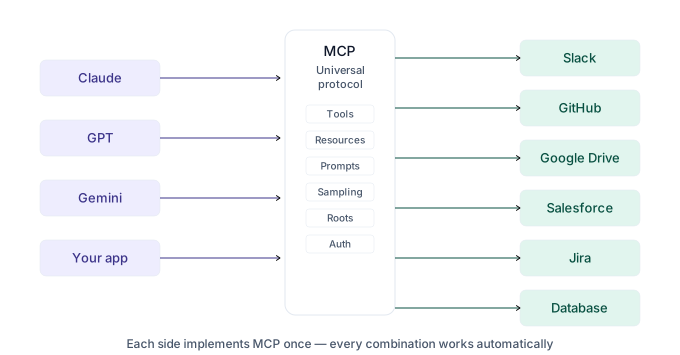
MCP is an open JSON-RPC protocol for connecting AI applications with tools, resources, prompts, and related capabilities. A compatible client and server can use the same interaction model instead of carrying a bespoke connector for that pair. Compatibility still depends on the protocol revision, transport, identity model, scope, network path, and the server operator.
What problem does MCP solve?
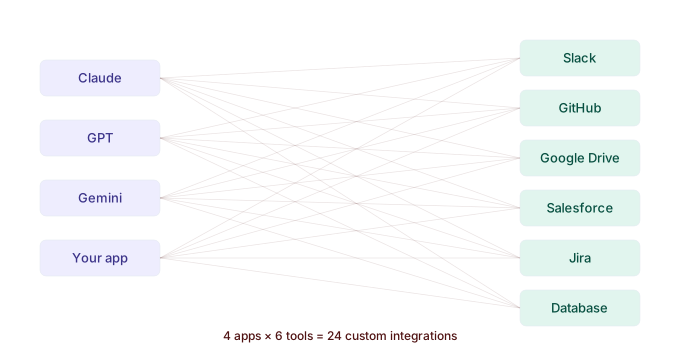
It can reduce the N × M integration surface. Without a shared protocol, five AI applications and eight systems can imply forty client-to-system connectors, each with its own auth, schema, error handling, and owner. MCP can move the protocol work towards N + M, but that is a planning model—not an automatic saving. The integration still needs compatible behaviour, authorisation, observability, and support.
How does MCP work — what are hosts, clients, and servers?
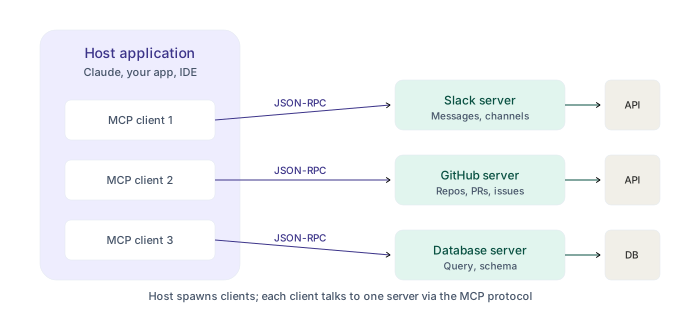
Three roles. The host is the AI application. It manages MCP clients, which connect to MCP servers. A server exposes one or more tools, resources, or prompts; it is not necessarily a single tool or a conventional infrastructure server. The important design question is ownership: which principal is acting, what scope is granted, and who investigates a failed or unexpected tool call?
Is MCP a single-vendor protocol or genuine industry infrastructure?
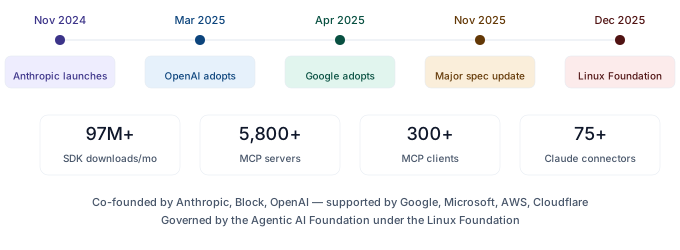
MCP is an Agentic AI Foundation project under the Linux Foundation and has an active specification and implementation ecosystem. That is a reason to evaluate it as a common contract, not a reason to treat it as mandatory. A production decision should rest on your target clients, server maturity, authorisation model, audit requirements, and exit cost.
When should we use MCP instead of building a custom integration?
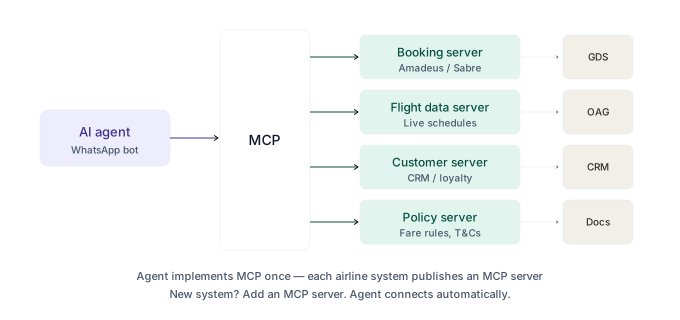
Use MCP when several compatible AI clients need a stable, governed way to reach the same system and you can own the server as production infrastructure. A bespoke connector can still be the lower-risk choice for a single bounded workflow, an unsupported client, or an API whose permissions cannot be constrained safely. Start with one reversible use case, then prove the identity, audit, and support model before widening access.
Diagrams
Embed these freely — each SVG is licensed CC BY (opens in a new tab) with attribution to this page baked in.