The most capable AI models available — and when a frontier model earns its cost vs when a small specialised model wins.
Share
Frontier models explained
Frontier models: the F1 cars of AI
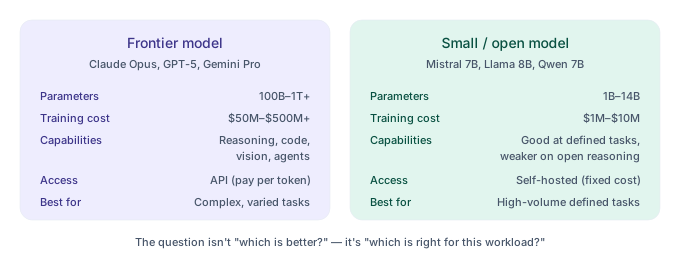
Frontier models are the most capable general-purpose AI models available — Claude Opus, GPT-5, Gemini Pro. They're trained on trillions of tokens with billions of parameters at a cost of $100M+. They can reason, write, code, analyse images, and handle tasks nobody explicitly trained them to do.
The business analogy: an F1 car. Astonishing engineering, extraordinary performance, astronomical running costs. Perfect for the qualifying lap. Terrible for the school run.
Frontier models: the F1 cars of AI
Frontier models are the most capable general-purpose AI models available — Claude Opus, GPT-5, Gemini Pro. They're trained on trillions of tokens with billions of parameters at a cost of $100M+. They can reason, write, code, analyse images, and handle tasks nobody explicitly trained them to do.
The business analogy: an F1 car. Astonishing engineering, extraordinary performance, astronomical running costs. Perfect for the qualifying lap. Terrible for the school run.
When frontier models earn their cost
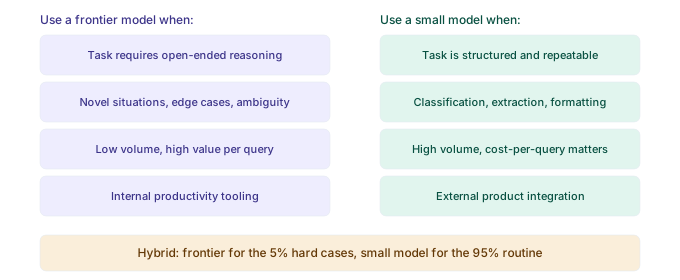
Frontier models are the right answer when the task requires broad reasoning, handles novel situations, or resists being reduced to a well-defined pattern. They're also the default for low-volume, high-value internal use.
Use a frontier model when the cost of a wrong answer exceeds the cost of the API call. Legal analysis, strategic decision support, complex customer escalations, creative work. Use a small model when the task is well-defined and repeatable.
Frontier models in 2026: the key players
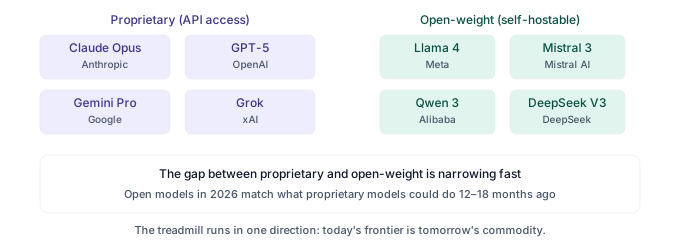
The proprietary frontier is led by Anthropic (Claude Opus), OpenAI (GPT-5), and Google (Gemini Pro). The open-weight frontier — models you can self-host — is led by Meta (Llama 4), Mistral, Alibaba (Qwen), and DeepSeek.
The strategic question: proprietary frontier models give maximum capability but lock you into a vendor API. Open-weight frontier models sacrifice some capability but give you control over deployment, cost, and data residency.
The real architecture: intelligent model routing
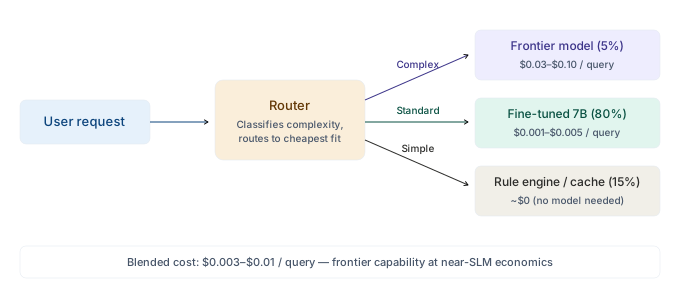
Production systems don't pick one model. They route each request to the cheapest model that can handle it. Simple classification goes to a 7B model ($0.001). Complex reasoning goes to a frontier model ($0.05). The router decides in milliseconds.
Figure 4The real architecture: intelligent model routing
This is how you get frontier capability without frontier costs. The router is the economic brain of the system — it turns a fixed "which model?" decision into a per-request optimisation problem.
Frequently asked questions
What is a frontier model?
A frontier model is one of the most capable general-purpose AI models available at any given moment — trained on trillions of tokens, with billions of parameters, at a cost north of $100M. They reason, write, code, analyse images, and handle tasks nobody explicitly trained them to do. The useful analogy is an F1 car: astonishing engineering, extraordinary performance, astronomical running costs. Perfect for the qualifying lap, terrible for the school run.
When does a frontier model earn its cost?
When the cost of a wrong answer exceeds the cost of the API call. That covers broad reasoning, novel situations, and anything that resists being reduced to a well-defined pattern — legal analysis, strategic decision support, complex customer escalations, creative work. It also covers low-volume, high-value internal use, where the token spend is trivial next to the value of the output. Where the task is well-defined and repeatable, a small model wins.
What is the difference between proprietary and open-weight frontier models?
Proprietary frontier models give you maximum capability behind a vendor API. Open-weight models — the ones you can download and self-host — give up some capability in exchange for control over deployment, cost, and data residency. The strategic question is not which scores higher on a benchmark; it is whether the capability gap is worth the lock-in, and whether your data is allowed to leave your estate at all.
What is model routing, and why do production systems use it?
Production systems do not pick one model — they route each request to the cheapest model that can handle it. Simple classification goes to a small model at a fraction of a penny; complex reasoning goes to a frontier model at fifty times the price. The router decides in milliseconds. This is how you get frontier capability without frontier costs: it turns a fixed "which model?" decision into a per-request optimisation.
Does every AI task need a frontier model?
No, and defaulting to one is the most expensive habit in enterprise AI. Using a frontier model to classify sentiment or extract fields from a form is couriering a Post-it note. Most production traffic is well-defined and repeatable, which is exactly what small specialised models are good at. Reserve the frontier tier for the fraction of requests that genuinely need it — and route the rest.