How a central platform team serves dozens of autonomous teams without becoming the bottleneck — the operating model behind an internal developer platform.
Share
The operating model
Click each idea to see the analogy and the lesson from running a central platform at scale.
One way in
The Front Door
"A hotel concierge, not a dozen scattered service desks"
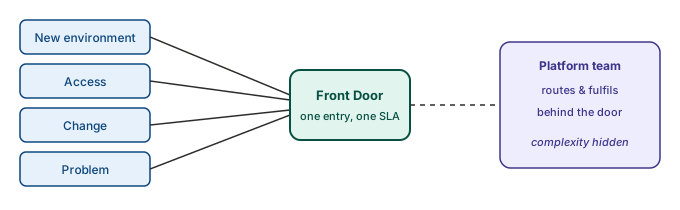
When every team has to know which queue to join — infra here, security there, networking somewhere else — the request dies in the gaps between them. A Front Door is a single, well-known entry point for every demand: a new environment, access, a change, a problem. Behind it, the platform team routes the work. In front of it, the developer sees one door and one SLA.
Running a central cloud platform across dozens of autonomous business units, the biggest single unlock wasn't a tool — it was agreeing one front door. The moment 'where do I even ask?' had a single answer, cycle times dropped and the shadow processes withered.
One way in
The Front Door
"A hotel concierge, not a dozen scattered service desks"
When every team has to know which queue to join — infra here, security there, networking somewhere else — the request dies in the gaps between them. A Front Door is a single, well-known entry point for every demand: a new environment, access, a change, a problem. Behind it, the platform team routes the work. In front of it, the developer sees one door and one SLA.
Running a central cloud platform across dozens of autonomous business units, the biggest single unlock wasn't a tool — it was agreeing one front door. The moment 'where do I even ask?' had a single answer, cycle times dropped and the shadow processes withered.
Self-service defaults
Paved Roads & Golden Paths
"A motorway with crash barriers — fast by default, hard to crash"
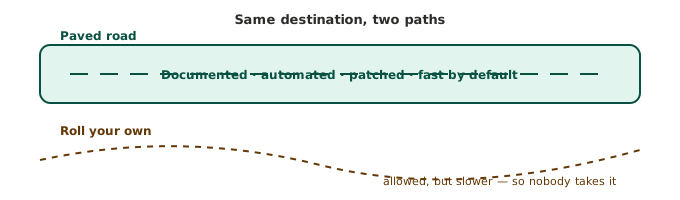
A paved road is the supported, opinionated way to do the common thing: spin up an environment, ship a service, wire up logging. It's not the only road, but it's the one that's documented, automated, and patched for you. Teams take it because it's the path of least resistance, not because a policy forces them.
Golden paths beat mandates. Teams route around a mandate; they queue up for a paved road that saves them a fortnight. If your 'standard' is slower than rolling their own, you don't have a standard — you have a suggestion nobody takes.
Frictionless governance
Guardrails, Not Gates
"Guardrails on a mountain road, not a checkpoint at every bend"
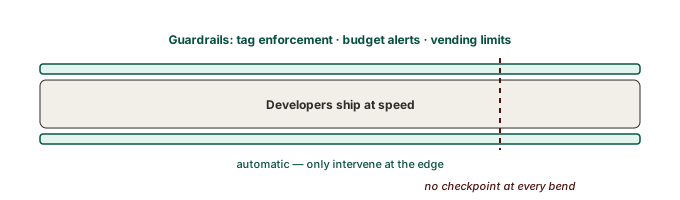
Gates stop everyone to catch the few who'd drive off the cliff. Guardrails let everyone drive at speed and only intervene when they're about to leave the road. In platform terms: encode policy as automated controls — budget alerts, tag enforcement, account vending with limits baked in — so governance happens by default, not by review board.
'Frictionless governance' sounds like a contradiction until you build it. The trick is to move the control from a human approval step to a pipeline check. The board that used to approve every change becomes the board that sets the rules the pipeline enforces.
Internal customers
Platform as a Product
"Run it like a SaaS company whose only customers are your own engineers"
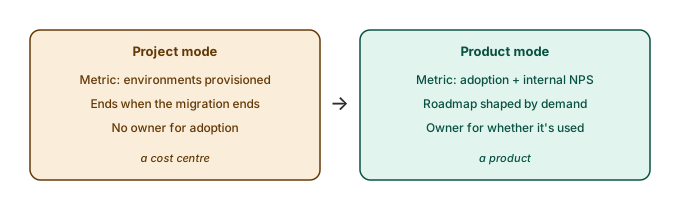
A platform run as a project ends when the migration ends. A platform run as a product has a roadmap, a backlog shaped by user demand, adoption metrics, and a team accountable for whether anyone actually uses it. The shift from 'did we deliver the thing' to 'are our customers succeeding' is the whole game.
The tell is the metric. Project-mode platforms report 'environments provisioned'. Product-mode platforms report adoption, time-to-first-deploy, and an internal NPS. If nobody owns whether developers are happy, the platform is a cost centre, not a product.
Central + autonomous
Federated Ownership
"A franchise: shared brand and standards, local ownership of the kitchen"
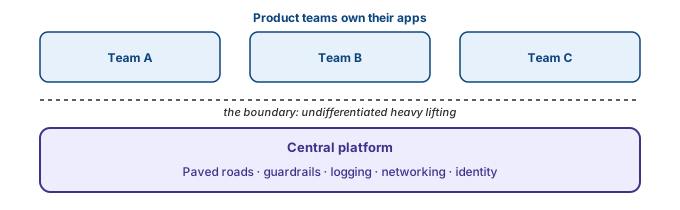
Centralise the platform — the paved roads, the guardrails, the shared services — and federate the apps. The central team owns the substrate everyone stands on; the product teams own what they build on top. Get the line wrong in either direction and you either recreate a bottleneck or a free-for-all of fifty incompatible setups.
The hardest part isn't technology, it's the boundary. Pull too much to the centre and you're the bottleneck you replaced. Push too much out and every team reinvents logging, networking, and identity badly. Draw the line at 'undifferentiated heavy lifting' — own that centrally, federate the rest.
From ticket-ops to self-service
Where does your platform sit on the path from a request queue to a product? Each rung narrows the bottleneck.
Platform maturity
The right-hand label is what the platform feels like to its users at each rung
Ticket-driven ops
Every change is a request to a central team
Bottleneck
Documented manual process
Self-serve the knowledge, not the action
Slow
Self-service with approvals
Automated vending, human sign-off
Better
Paved roads + guardrails
Governance encoded in the pipeline
Fast
Platform as a product
Adoption-driven roadmap, internal NPS
Compounding
The jump that matters is from "self-service with approvals" to "guardrails in the pipeline" — that is where the central team stops being the bottleneck.
Decision framework
Frequently asked questions
What is a platform operating model?
It is how a central platform team serves dozens of autonomous teams without becoming the bottleneck between them and production. The model has five parts: a single front door for demand, paved roads that make the supported path the fast one, guardrails that encode policy as automated checks, the platform run as a product rather than a project, and a clear line between what is centralised and what is federated.
What is a paved road or golden path?
The supported, opinionated way to do the common thing — spin up an environment, ship a service, wire up logging — documented, automated, and patched for you. It is not the only road, but it should be the path of least resistance. Golden paths beat mandates, because teams route around a mandate and queue up for a road that saves them a fortnight. If your standard is slower than rolling their own, you do not have a standard; you have a suggestion nobody takes.
What is the difference between guardrails and gates?
Gates stop everyone to catch the few who would drive off the cliff. Guardrails let everyone travel at speed and intervene only when they are about to leave the road. In practice that means moving the control from a human approval step to a pipeline check — budget alerts, tag enforcement, account vending with limits baked in. The board that used to approve every change becomes the board that sets the rules the pipeline enforces.
How does a central platform team avoid becoming the bottleneck?
By climbing off the request queue. The path runs from ticket-driven ops, through documented manual process, to self-service with approvals, then paved roads with guardrails, and finally platform as a product. The jump that matters is from self-service-with-approvals to guardrails-in-the-pipeline — that is the point where the central team stops being in the critical path of every change.
What does running the platform as a product mean?
A roadmap shaped by user demand, adoption metrics, and someone accountable for whether developers are actually succeeding. The tell is the metric you report: project-mode platforms count environments provisioned; product-mode platforms track adoption, time-to-first-deploy, and internal NPS. A platform run as a project ends when the migration does. Without an accountable product owner it drifts back into a ticket queue and becomes a cost centre.