AI Cost Curves
When API costs cross the self-hosting line — the economics that drive AI infrastructure decisions, and how to spot the crossover before it hits your bill.
The economics explained
Click each model to see the cost dynamics and visual explanation.
The cost ladder
One workload, priced five ways — 100,000 queries a day, 4,000 tokens in and 600 out.
Infrastructure choices at 100K queries/day
Each rung is the same traffic on different infrastructure, at $2.50 / $10 per million tokens
- $48K/mo
- $30K/mo
- $13.7K/mo
- $6.5K/mo
- $5.1K/mo
Halve the query length and every self-hosted rung holds while the API rung halves — which is why the crossover moves with query shape, not only with volume.
Find the request volume where self-hosted AI inference starts to beat per-token API pricing — an interactive calculator for AI cost crossover points.
Decision framework
Frequently asked questions
What is an AI cost curve?
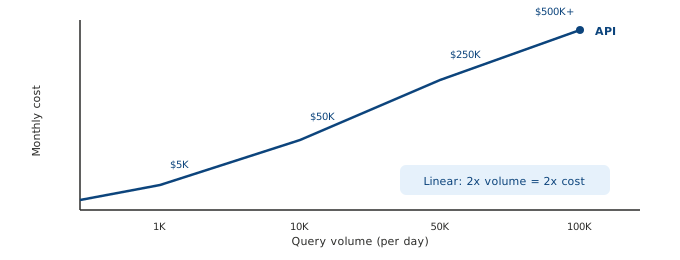
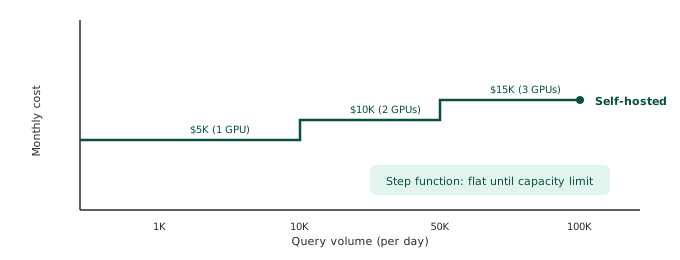
An AI cost curve plots the total cost of serving inference against request volume for each infrastructure option — per-token API, self-hosted GPU, and hybrid. API pricing is a straight line through the origin (you pay per request, forever); self-hosting is a high fixed cost plus a near-flat marginal cost. Comparing the curves shows where one option overtakes another as volume grows.
What is the crossover point, and how do I find it?
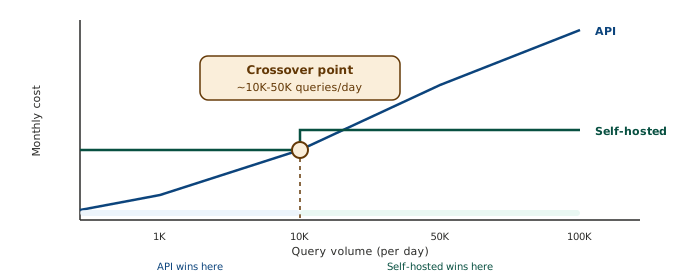
The crossover point is the request volume where a fixed-cost self-hosted setup becomes cheaper than per-token API pricing. Find it by dividing the fully-loaded monthly cost of the self-hosted option (GPU, hosting, and the engineering time to run it) by the per-request API price. Below that volume, APIs win on total cost; above it, self-hosting does — assuming you can keep the GPU busy.
At what volume does self-hosting beat API pricing?
There is no universal number — it depends on your per-request API price, model size, and how fully you utilise the hardware. As a rule of thumb: under ~1K requests/day, APIs almost always win because engineering overhead dwarfs token spend; between 1K and 50K/day is the benchmark zone; above ~50K/day the economics usually favour self-hosting the bulk of traffic. Always validate with a real benchmark on your own prompts.
Does self-hosting include the cost of running it?
It must, or the comparison is wrong. The honest self-hosted figure is GPU or instance cost plus storage and networking plus the engineering time to deploy, monitor, patch, and keep the model current. Teams that only count the GPU bill systematically overstate the savings and cross over later than the spreadsheet predicts.
Why does a hybrid approach cut costs so much?
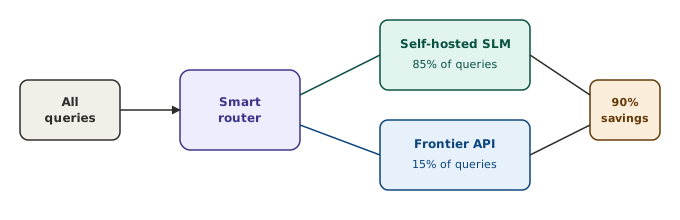
Most workloads are long-tailed: the majority of requests are simple and a small fraction need frontier reasoning. Routing the bulk (often 85%) to a cheap self-hosted small model and reserving a frontier API for the hard 15% captures most of the self-hosting savings while keeping quality where it matters — commonly around a 70% reduction versus sending everything to a frontier API.
Diagrams
Embed these freely — each SVG is licensed CC BY (opens in a new tab) with attribution to this page baked in.