Agentic AI Patterns
From single agents to orchestrated teams — the architecture patterns behind AI that acts, and how to choose between them without over-engineering.
The patterns
Click each pattern to see the architecture and business context.
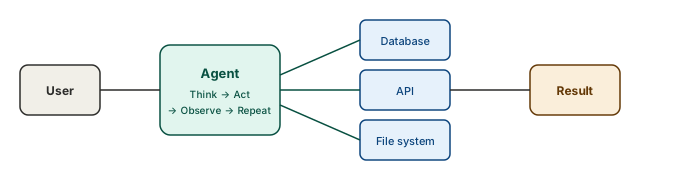
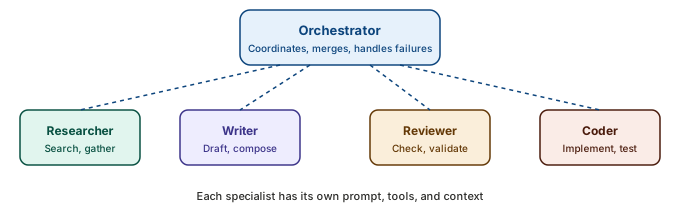
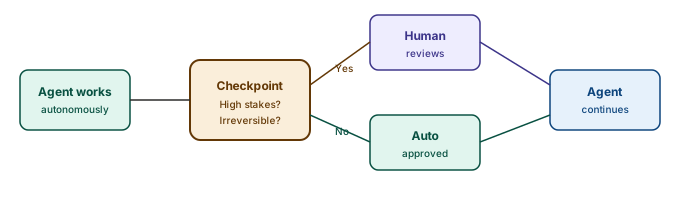
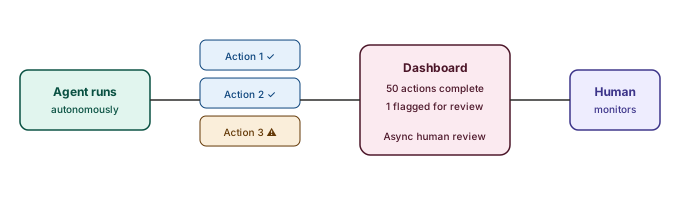
Compare the canonical agentic AI patterns side-by-side — trade-offs, best-fit workloads and worked examples, in an interactive pattern explorer.
Decision framework
Frequently asked questions
What is an AI agent, and how is it different from a chatbot?
An agent receives a goal, breaks it into steps, and uses tools to accomplish them — reading data, calling APIs, writing files, checking its own work. It runs a loop: think, act, observe, repeat. A chatbot answers questions; an agent takes actions. That single difference is what makes agents valuable and what makes them a governance problem, because the actions are real and some of them cannot be undone.
When should I use multi-agent orchestration instead of a single agent?
Later than you think. A single well-prompted agent with the right tools handles the large majority of automation tasks, and over-engineering with multiple agents when one would do is the most common mistake in agentic AI. Split the work only when the task genuinely needs different expertise, or when one context window cannot hold it. Coordination is not free — message passing, error handling, and state management are all real costs.
What is the difference between human-in-the-loop and human-on-the-loop?
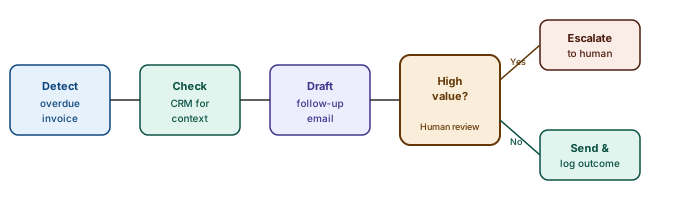
In-the-loop means the agent pauses and waits for approval before a defined action — sending the email, making the payment, deleting the data. On-the-loop means the agent acts autonomously while a human supervises the output and can intervene or shut it down. In-the-loop is co-signing; on-the-loop is supervision. Mature deployments start in-the-loop, measure the error rate, and shift to on-the-loop as confidence builds, reserving co-signing for genuinely irreversible actions.
How do I know whether a task is a good fit for an agent?
Two tests. First, is the task well-defined with a clear definition of done? Vague goals like "improve the report" produce loops and wasted tokens — write the pass/fail criteria before you build anything. Second, can a failure be safely reversed? If not, put a human checkpoint in front of the irreversible step. Start with read-only agents and widen the permissions as the error rate earns it.
How do agents connect to the systems they need to act on?
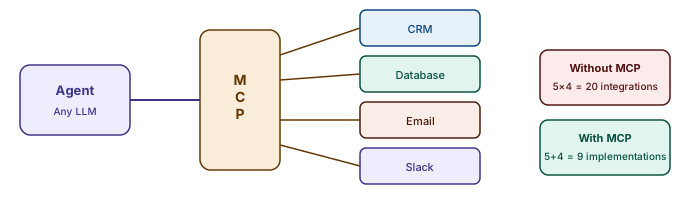
Through tools, and at any scale that means a standard protocol rather than bespoke connectors. An agent without tools is just a chatbot. MCP lets you expose each system once and have any compliant agent use it, which turns five agents across four tools from twenty custom integrations into nine implementations. That ratio is the difference between a demo and something you can run across an enterprise.
How do I justify the cost of building an agent?
Multiply time saved per task by frequency, and compare it to build plus maintenance. An agent that saves ten minutes once a month is not worth building. An agent that saves two minutes two hundred times a day is transformative. The maths is unglamorous and it kills most agent proposals before they consume a quarter — which is exactly what it is for.
Diagrams
Embed these freely — each SVG is licensed CC BY (opens in a new tab) with attribution to this page baked in.