From cloud chaos to cost control — the framework for regaining economic independence from hyperscaler lock-in.
Share
The promise vs the reality
Cloud services promised transformative cost savings and agility. Lower infrastructure investment, pay-as-you-go flexibility, rapid scaling capabilities. For many, the reality has been different.
🔒
Vendor Lock-In
Proprietary services tie your hands. Switching means major rewrites.
🏨
Exit & Egress Costs
The "Hotel California" effect — terribly expensive to leave.
🔍
Opaque Pricing
34% of SMBs report significantly higher cloud spend than expected.
⚠️
Innovation Tax
Teams afraid to adopt new features due to unforeseen charges.
Resources are underutilised, driving significant waste — idle infrastructure, overprovisioned services, forgotten zombie resources. Cloud chaos erodes margins and flexibility.
The sovereignty maturity ladder
Economic sovereignty is a journey from maximum dependency to full cost control.
Sovereignty maturity
Each rung represents greater control over your infrastructure economics
Single cloud, proprietary services
Maximum vendor lock-in
High risk
Multi-cloud with some portability
Reduced but still vendor-dependent
Medium risk
Open-source core + abstraction layers
Freedom of movement
Low risk
Full economic sovereignty
Portability, transparency, exit strategy
Controlled
Most organisations are between rung 1 and 2. The goal isn't rung 4 for everything — it's choosing the right rung per workload.
The four pillars
Click each pillar to see the framework detail and visual explanation.
Architecture
Portability by Design
"Build on a flatbed, not a foundation — if the ground shifts, you can move"
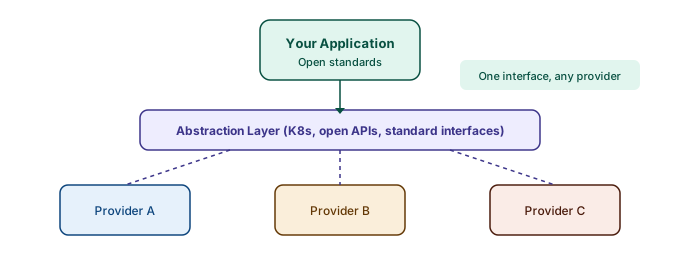
Architect systems to move freely between providers. This means open-source databases instead of proprietary ones, Kubernetes instead of vendor-specific container services, and standard APIs instead of cloud-native SDKs. Short-term, it requires more deliberate design. Long-term, it's the difference between negotiating from strength and begging for mercy.
Portability isn't about leaving — it's about leverage. When your vendor knows you can leave, renewal conversations go very differently. Organisations with genuine multi-cloud capability report 15-25% better commercial terms.
Architecture
Portability by Design
"Build on a flatbed, not a foundation — if the ground shifts, you can move"
Architect systems to move freely between providers. This means open-source databases instead of proprietary ones, Kubernetes instead of vendor-specific container services, and standard APIs instead of cloud-native SDKs. Short-term, it requires more deliberate design. Long-term, it's the difference between negotiating from strength and begging for mercy.
Portability isn't about leaving — it's about leverage. When your vendor knows you can leave, renewal conversations go very differently. Organisations with genuine multi-cloud capability report 15-25% better commercial terms.
Visibility
Transparency & Control
"You can't negotiate a bill you can't read"
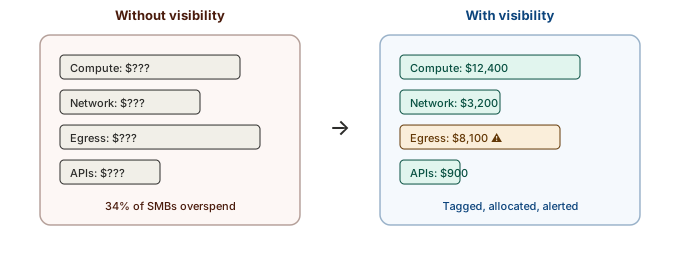
Cloud billing is deliberately opaque. Compute, storage, network, data transfer, API calls, logging, monitoring — each with its own pricing model, unit, and tier. 34% of SMBs report significantly higher cloud spend than expected. The complexity isn't a bug; it's a business model. Clear cost visibility means tagging, allocation, and real-time dashboards — before the invoice arrives.
No blank cheques. Every workload should have an owner, a budget, and an alert. Teams afraid to adopt new features due to unforeseen charges are teams that stop innovating. Transparency breaks that cycle.
Strategy
Exit Strategy Planning
"Plan your exit before you enter — the Hotel California of cloud"
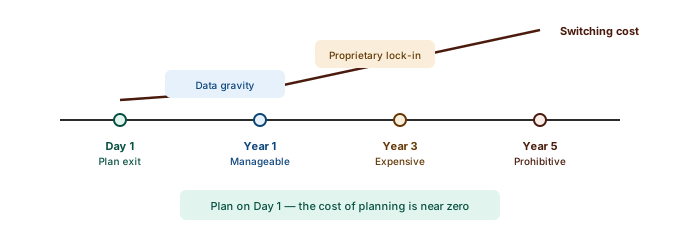
Every cloud migration should start with a question: what does it cost to leave? Data egress fees, proprietary service dependencies, retraining teams on new tools — these are the real switching costs. They're designed to be high enough that leaving is always more painful than staying. An exit strategy isn't pessimism. It's due diligence.
The cost of switching providers grows exponentially with time. Year one: manageable. Year five: prohibitive. Plan your exit architecture on day one, even if you never use it. The planning alone will force better design decisions.
Implementation
Service Abstraction in Action
"A universal adapter — your apps talk to interfaces, not providers"
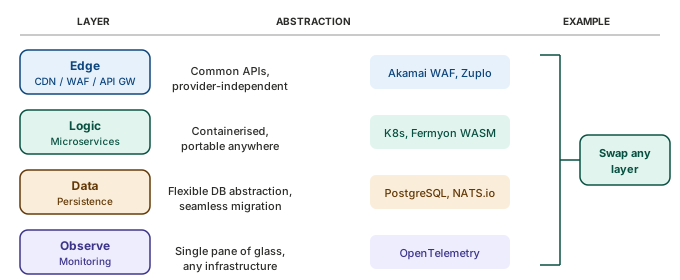
An abstraction layer sits between your applications and cloud services. Your code talks to standard interfaces; the abstraction handles the provider-specific translation. Four layers matter most: edge (CDN/WAF), business logic (containers), data persistence (databases), and observability (monitoring). Each can be swapped independently.
Real-world proof: Synadia (NATS.io) for messaging, Zuplo for multi-cloud API gateways across 300+ locations, Fermyon for WebAssembly serverless that runs anywhere. These aren't theoretical — they're production infrastructure decoupling apps from providers today.
The proof
Organisations embracing open infrastructure and cloud portability are seeing real results.
The pattern scales: a 50-person company saves $10M+, a pre-IPO company saves $75M, and industry-wide nearly a third of all cloud spend is pure waste. The question isn't whether you're overspending — it's by how much.
The AI frontier
New technology, old trap. The risk of AI vendor lock-in mirrors cloud lock-in. Today's leading model might be overtaken tomorrow. Proprietary AI services create the same dependency patterns that cloud created a decade ago.
Explore domain-specific Small Language Models. Maintain open ecosystems. The sovereign AI approach preserves both economic and technical independence.
The same four pillars apply: portable model formats, transparent inference costs, an exit strategy that doesn't require retraining from scratch, and abstraction layers that decouple your logic from specific providers.
Economic sovereignty is the ability to change your infrastructure arrangements when the economics change — to move a workload, renegotiate a contract, or replace a service without rewriting your product. It is distinct from data sovereignty, which is about jurisdiction and residency. You can be fully compliant on where your data sits and still have no practical ability to leave the provider holding it.
What are the four pillars of a sovereignty strategy?
Portability by design — open-source databases, standard APIs, and orchestration that is not vendor-specific. Transparency and control — tagging, allocation, and real-time cost visibility, because you cannot negotiate a bill you cannot read. Exit strategy planning — knowing what leaving costs before you commit. And service abstraction — a layer between your applications and provider services, so edge, business logic, data, and observability can each be swapped independently.
How do I work out my exit cost?
Add up data egress fees, data transfer costs, the re-architecture effort for every proprietary service you depend on, retraining staff on new tooling, and any contract penalties. Then do it again for one year, three years, and five. Most organisations underestimate by a factor of three to five, and the number climbs every quarter — year one is manageable, year five is prohibitive. If you cannot answer this question at all, that is your first action item.
Does sovereignty mean abandoning the hyperscalers?
No. Sovereignty is about leverage, not exit. The point of being able to move is that you rarely have to — renewal conversations go differently when the provider knows you have somewhere to go, and organisations with genuine multi-cloud capability report meaningfully better commercial terms. The goal is not the top rung of the ladder for everything; it is choosing the right rung per workload.
Do AI investments create new lock-in?
Yes, and it is being accrued faster than the cloud lock-in that preceded it. Proprietary model formats, single-vendor inference APIs, and non-portable training pipelines are each a new dependency, usually signed off without the exit analysis that a database migration would attract. Apply the same test to AI that you would to any infrastructure commitment: what does it cost to move this to another provider, and how much does that number grow each year?
What is a realistic first step?
Pick one thing and measure it. Replace a single proprietary service with an open equivalent — object storage, a database, container orchestration are the usual candidates — and record what it actually cost. Or take one workload and run it on two providers. The learning alone justifies the investment, because true multi-cloud is not running the same thing twice; it is having the architecture, tooling, and team capability to move when the economics shift.