The premium on a managed database, queue or search service buys an on-call rota. Self-running open source wins only when the fleet is large enough to spread that fixed cost.
Share
What the managed premium buys, and what replaces it
Four views of one decision. Every figure on this page is illustrative or a stated assumption, to be replaced with numbers from your own estate.
The managed price is compute plus labour you do not see
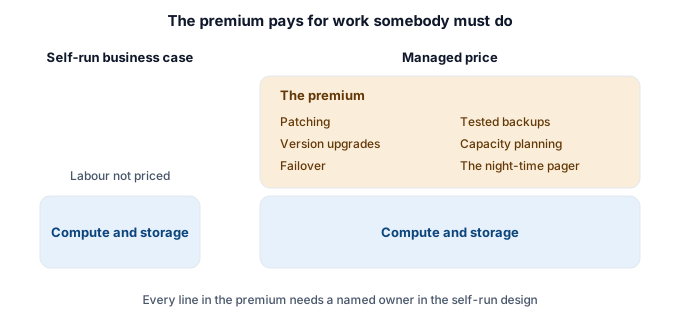
A managed database, queue or search service costs more than the machines underneath it. The difference pays for patching, version upgrades, failover, tested backups, capacity planning and somebody who answers the page at night. A business case that compares the managed price with raw compute has priced the machines and left the labour out.
Figure 1The managed price is compute plus labour you do not see
Before arguing about the size of the premium, list what it covers and put a name against each line in the self-run design. A line with no name is work nobody has agreed to do.
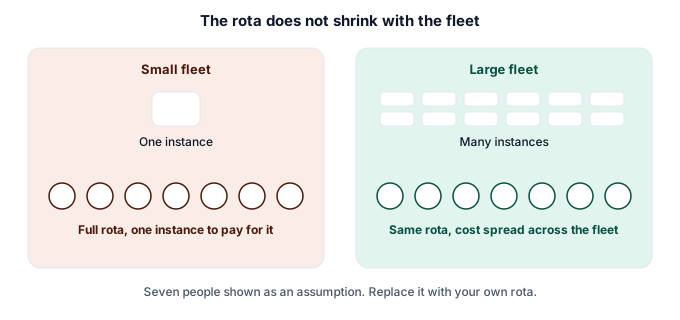
One instance needs the same rota as fifty
Round-the-clock cover is a number of people, and that number does not shrink with the fleet. One engineer on call every week is an attrition plan. As an assumption to replace with your own, sustainable cover needs six to eight engineers who know the technology well enough to repair it under pressure. That cost arrives in full with the first production instance.
This is why a small estate rarely wins by self-running. The saving is per instance and the rota is per technology, so the first few instances carry a rota they cannot pay for.
Self-running pays once the fleet covers the rota
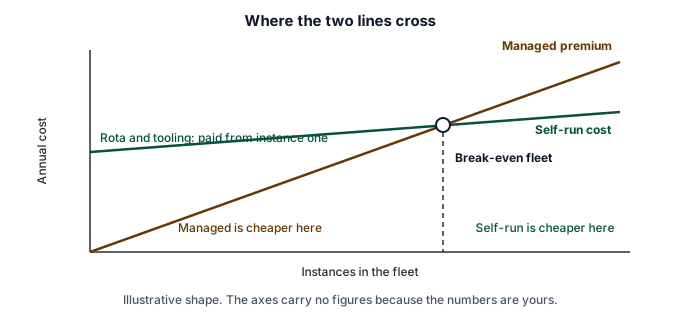
The managed premium grows with every instance. The fixed cost of self-running stays roughly flat, with a smaller amount per instance for upgrades and incidents. The two lines cross at a fleet size you can calculate: the fixed cost divided by the saving on each instance. Below that fleet size, self-running costs more. Above it, the gap widens with each instance added.
Figure 3Self-running pays once the fleet covers the rota
Ask for the break-even fleet size before the migration plan. If the estate is at a third of it and not growing, the answer is to stay managed and spend the effort elsewhere.
Self-running changes the supplier risk. It does not remove it
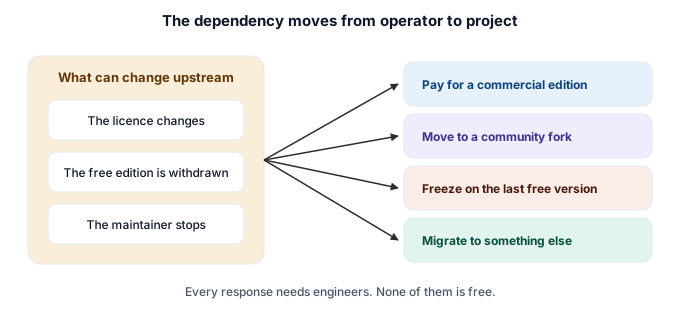
Running open-source software yourself ends the dependency on a service operator. It leaves a dependency on the project. A licence can change, a free edition can be withdrawn, and a maintainer can stop. Each of those forces a choice between paying, forking, freezing on an old version or migrating, and each choice needs engineers.
Figure 4Self-running changes the supplier risk. It does not remove it
Put the project in the supplier register alongside the service it replaced. Record who maintains it, what the licence permits, and what the team would do in the quarter after a change.
Five ways to operate the same technology. The right-hand label is what each one costs you.
Operating models for a data service
From an operator carrying everything to a shared internal service
Fully managed
The operator patches, upgrades, recovers and carries the pager
Premium per instance
Managed with an exit tested
Standard interfaces, exports rehearsed, restore proven elsewhere
Premium plus a drill
Self-run by each team
Every team operates its own instances and its own on-call
A rota per team
Self-run as a shared service
One team operates the technology for every tenant
One rota, shared
Internal managed service
Shared rota, published service levels, a price per instance
Rota spread thin
The third rung is the expensive one. Each team that self-runs alone pays for a full rota, or goes without one and finds out during an incident. If the fleet justifies self-running, pool it.
Is self-running open source cheaper than a managed service?
It depends on fleet size. The managed premium is paid per instance. Self-running has a fixed cost, mostly the on-call rota, plus a smaller cost per instance. Below the break-even fleet size the managed service is cheaper. Above it, self-running is cheaper and the gap grows with each instance.
What does the managed premium pay for?
Patching, version upgrades, failover, tested backups, capacity planning and round-the-clock incident response. A comparison between the managed price and raw compute leaves all of that labour out of the self-run side.
How many engineers does a self-run service need?
Enough for sustainable round-the-clock cover. This page uses six to eight as an assumption, and you should replace it with your own figure. The number does not fall when the fleet is small, which is why small estates rarely save money by self-running.
How do I calculate the break-even fleet size?
Add up the fixed annual cost of self-running: the share of the rota spent on the service, plus tooling. Divide it by the annual saving per instance, which is the managed premium less the per-instance cost of upgrades and incidents. The result is the number of instances at which the two options cost the same.
Does self-running remove vendor lock-in?
It removes the dependency on a service operator and leaves a dependency on the open-source project. Licences change, free editions are withdrawn and maintainers stop. Each event forces a choice between paying, forking, freezing or migrating, and each choice costs engineering time.
What is an internal managed service?
A shared team that operates a technology for every tenant in the organisation, with a published service level and a price per instance. It spreads one rota across the whole fleet. It is the model that makes self-running pay at scale, and it needs funding and ownership like a product.